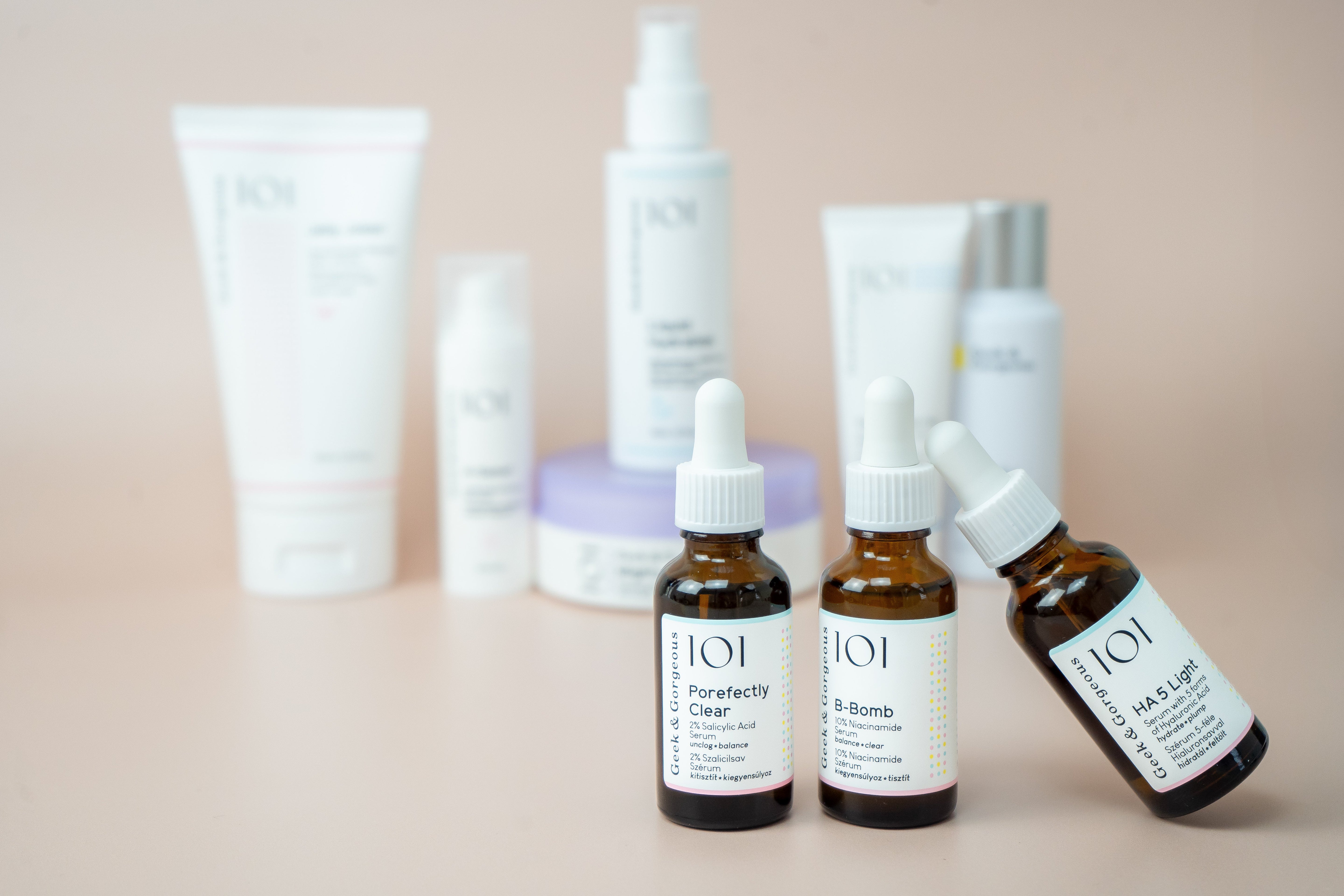


Savoir superposer les soins vous permettra de créer une routine cohérente et efficace. L'ordre, le moment et la compatibilité des ingrédients sont primordiaux pour optimiser l'action des actifs, que votre objectif soit l'hydratation, l'éclat, le contrôle de l'acné ou le rajeunissement du teint. Ce guide vous explique, exemples à l'appui, l'ordre, le moment et la compatibilité des ingrédients pour vous aider à élaborer votre routine, même si vous débutez dans les soins de la peau.
Principes de la superposition des soins de la peau
1. Texture : fine à épaisse
Le moyen le plus simple de se souvenir de l'ordre est d'appliquer les produits du plus fluide au plus épais :
- Essences aqueuses et toniques
- Sérums et traitements légers
- sérums plus épais/laiteux
- Crèmes hydratantes
- Huiles et baumes
- Crème solaire (dernière étape du matin)

2. Tenez compte du pH et de la compatibilité des ingrédients
Certains principes actifs sont plus efficaces à des niveaux de pH spécifiques. Par exemple, les acides alpha-hydroxylés (AHA). Leur efficacité est optimale à un pH plus bas, de même qu'avec certains dérivés de la vitamine C. En revanche, certaines associations peuvent provoquer des irritations (voir plus bas). En cas de doute, il est conseillé d'intégrer les actifs puissants (par exemple : AHA, rétinoïdes, vitamine C…) à différentes routines (en alternant les soirs ou le matin et le soir).
3. Temps d'attente : la patience est récompensée
La plupart des produits pénètrent en un instant, 30 à 60 secondes suffisent. Cependant, les actifs puissants comme les sérums à la vitamine C ou les exfoliants chimiques peuvent bénéficier de quelques minutes de pose avant l'application d'une crème hydratante. Ceci permet non seulement d'éviter les irritations, mais aussi d'optimiser leur efficacité. Personnellement, je préfère prendre un café ou me brosser les dents après avoir appliqué la vitamine C et avant d'appliquer ma crème hydratante.
4. Appliquer les actifs de manière stratégique (matin vs après-midi)
Certains ingrédients sont à privilégier le matin grâce à leur protection antioxydante contre les rayons UV (par exemple, la vitamine C et la niacinamide), tandis que d'autres sont plus adaptés au soir (rétinoïdes et exfoliants chimiques puissants) en raison de la photosensibilité qu'ils peuvent engendrer . L'application de ces produits doit tenir compte du moment de la journée afin de protéger la peau et de favoriser sa réparation pendant la nuit.
5. Tests épicutanés et introduction progressive
Introduisez un nouveau produit à la fois , surtout les actifs. Effectuez un test cutané sur la mâchoire ou l'intérieur de l'avant-bras et attendez 48 à 72 heures pour observer les réactions. Augmentez progressivement la fréquence d'utilisation : par exemple, utilisez le rétinol une fois par soir, puis deux fois, puis un soir sur deux, et ainsi de suite.
Quels ingrédients de soin puis-je combiner ?
Bonnes combinaisons d'ingrédients
Acide hyaluronique + Presque tout
L'acide hyaluronique est un excellent hydratant et se combine parfaitement avec la plupart des actifs. Il aide à lutter contre la sécheresse causée par des ingrédients comme les rétinoïdes, les acides exfoliants ou la vitamine C.
Niacinamide + Céramides
Voici une équipe de choc pour renforcer la barrière cutanée. La niacinamide favorise la résilience et l'équilibre de la peau, tandis que les céramides retiennent l'hydratation et renforcent la barrière cutanée — idéal pour les peaux sensibles, déshydratées ou fragilisées.
Rétinoïdes + Ingrédients apaisants (Centella, Panthénol, Allantoïne)
Les rétinoïdes sont puissants mais peuvent être irritants. Les associer à des ingrédients apaisants permet de réduire les rougeurs, la sécheresse et l'inconfort, tout en autorisant une utilisation régulière sur le long terme.
Vitamine C + Crème solaire (routine du matin)
La vitamine C aide à protéger la peau du stress oxydatif, et la crème solaire la protège des dommages causés par les UV. Ensemble, ils offrent une protection renforcée contre le vieillissement prématuré et l'hyperpigmentation.
AHA/BHA + Ingrédients hydratants et réparateurs de barrière cutanée
Les acides exfoliants sont plus efficaces lorsqu'ils sont suivis d'une hydratation et d'un soin protecteur de la barrière cutanée. Cette combinaison permet de conserver une peau lisse sans l'agresser.

Combinaisons d'ingrédients à éviter
Rétinoïdes + Acides exfoliants (AHA/BHA)
L'utilisation simultanée de ces produits dans une même routine peut facilement agresser la peau et provoquer des irritations, une sécheresse et une altération de la barrière cutanée. Il est préférable de les utiliser en alternance, un soir sur deux.
Vitamine C + Acides forts
L'association de vitamine C et d'acides exfoliants peut déstabiliser la formule et accroître la sensibilité. Si vous utilisez les deux, appliquez la vitamine C le matin et les acides le soir.
Plusieurs actifs puissants simultanément
Plus n'est pas mieux. Combiner rétinoïdes, acides et vitamine C à forte concentration dans une même routine augmente le risque d'irritation sans améliorer les résultats.
Huiles essentielles + routines actives et intenses
Bien que n'étant pas intrinsèquement « mauvaises », les huiles essentielles peuvent être sensibilisantes, surtout lorsqu'elles sont associées à des actifs puissants. Les peaux sensibles doivent donc utiliser cette combinaison avec précaution.
Quel est l'ordre de superposition correct ?
Vous trouverez ci-dessous des routines pratiques et réalistes que vous pouvez adapter à votre type de peau, votre âge et votre style de vie. Chaque routine indique l'ordre d'application habituel des produits et propose des exemples adaptés aux problèmes les plus courants.
Routine matinale de base (minimaliste)
- Nettoyant — mousse ou gel doux et non desséchant. Élimine le sébum accumulé pendant la nuit sans altérer la barrière cutanée.
- Lotion tonique ou essence hydratante — facultative ; apporte une hydratation légère.
- Sérum antioxydant — vitamine C ou niacinamide pour protéger contre les dommages environnementaux.
- Crème hydratante — choisissez une texture adaptée à votre type de peau (gel pour les peaux grasses, crème pour les peaux sèches).
- Crème solaire — à large spectre FPS 30+ (dernière étape du matin ; réappliquer toutes les deux heures en cas d’exposition).
Routine du soir de base (réparation et hydratation)
- Démaquillant / nettoyant à base d'huile (en cas de maquillage ou de protection solaire)
- nettoyant doux à base d'eau
- Lotion tonique ou essence
- Sérums de traitement (rétinol, peptides, actifs ciblés)
- Crème hydratante
- Huile pour le visage ou baume de nuit (facultatif)
Appliquer les produits dans le mauvais ordre
Nous l'avons déjà mentionné. Appliquer une crème riche avant un sérum empêche les principes actifs de pénétrer. Réorganisez vos produits de manière à appliquer d'abord les formules légères.
Ne pas laisser les produits s'absorber
Appliquer immédiatement l'étape suivante risque de diluer le produit précédent. Attendre une minute ou deux peut faire toute la différence !
Problèmes courants liés à la superposition des soins de la peau
Boulochage (détachement du produit)
Le boulochage se produit lorsque les produits ne sont pas complètement absorbés ou lorsque des textures incompatibles se superposent mal. Cela peut même arriver avec la crème solaire, qui doit former un film protecteur pour offrir une protection efficace. Si vous constatez un boulochage, vous pouvez :
- Réduisez la quantité de chaque produit
- Réduisez les étapes de votre routine de soins de la peau
- Laissez plus de temps pour absorber
- Évitez d'appliquer les bases de teint épaisses à base de silicone directement sur les sérums hydratants.
Irritation ou rougeur
Cessez l'introduction de nouveaux actifs et privilégiez une routine douce pour réparer la barrière cutanée : nettoyant, crème hydratante aux céramides et protection solaire. Réintroduisez un produit à la fois une fois les symptômes disparus.
Les produits semblent inefficaces
La patience est essentielle ! Les actifs mettent des semaines, voire des mois, à faire effet. Pour un teint plus éclatant et une correction des taches pigmentaires, il faut souvent compter 8 à 12 semaines avant de constater des changements visibles. Les traitements stimulant le collagène (rétinoïdes, peptides, procédures professionnelles) peuvent prendre plusieurs mois avant d’apporter un effet raffermissant. Se fixer des échéances réalistes permet de rester motivé et régulier.
Si un produit ne montre aucun effet après quelques mois, envisagez de changer de concentration ou d'essayer un autre actif adapté à votre problème.
Liste de vérification finale : superposition correcte à chaque fois
- Nettoyez votre bouche en fonction du moment de la journée.
- Appliquez les produits à base d'eau avant les produits à base d'huile.
- Utilisez les actifs puissants de manière stratégique (matin ou soir) et alternez si nécessaire.
- Attendez quelques instants entre les couches — plus longtemps pour les actifs puissants.
- Terminez toujours votre routine matinale par l'application d'une crème solaire à large spectre.
- Introduisez un nouveau produit à la fois et effectuez d'abord un test cutané.

Foire aux questions
Combien de temps faut-il attendre entre les couches ?
En général, 30 à 60 secondes suffisent pour la plupart des produits. Pour les actifs puissants (vitamine C, acides, rétinol), attendre 1 à 3 minutes ou appliquer une crème hydratante légère en guise de tampon réduit l'irritation et permet aux actifs de pénétrer.
Les produits peuvent-ils être mélangés avant application ?
Mélanger quelques produits compatibles est une bonne idée. Par exemple, un sérum hydratant associé à une crème hydratante ne pose généralement pas de problème et permet de gagner du temps. Évitez de mélanger des actifs puissants (acides forts et rétinol) sauf avis contraire d'un professionnel.
Est-il nécessaire d'utiliser à la fois la vitamine C et la niacinamide ?
Ils offrent des bienfaits complémentaires (la vitamine C illumine le teint et offre une protection antioxydante ; la niacinamide atténue les rougeurs et renforce la barrière cutanée). Nombreuses sont les personnes qui les utilisent ensemble ; on peut les superposer, les appliquer matin et soir, ou alterner selon la tolérance.
Combien de produits représentent un excès ?
L'important n'est pas tant la quantité que la compatibilité. Une routine simple et régulière, avec des actifs ciblés, est souvent plus efficace qu'une routine complexe.